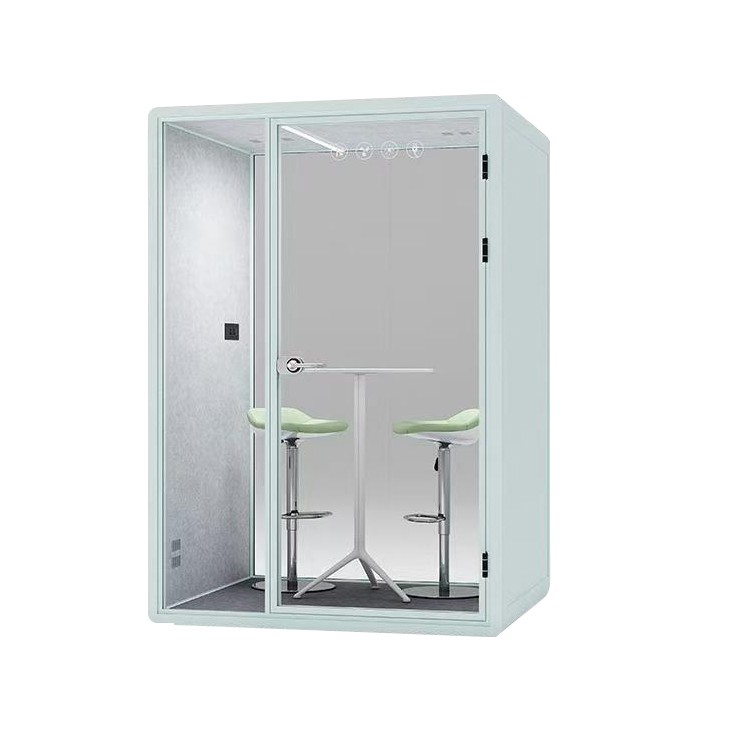
Analysis of Commonly Used Soundproofing Materials for Soundproof Office Partitions
The soundproofing effect of soundproof office partitions depends crucially on the selection of soundproofing materials and common materials can be divided into three main categories which are sound-absorbing materials sound-isolating materials and composite sound-isolating materials. Different materials vary significantly in performance environmental friendliness and fire rating with specific categories and characteristics as follows:
1. Sound-Absorbing Materials: Absorb Sound Waves and Reduce Internal Echoes
Sound-absorbing materials convert incident sound waves into heat energy through their porous structures or interfiber gaps and they are mainly used to reduce echo and reverberation inside partitions and improve sound clarity with common types including:
Rockwool is a fibrous material made from basalt and diabase through high-temperature melting with a porosity of over 90% and a high sound absorption coefficient (0.5-0.8) for mid- and high-frequency sound waves (such as human voices and keyboard tapping sounds). It meets the GB 8624 Class A fire rating (non-combustible material) and contains no harmful substances like formaldehyde with excellent environmental friendliness. Rockwool fibers are highly hygroscopic so a moisture-proof layer is required in environments with prolonged humidity (such as the rainy season in southern China) to prevent the material from getting damp and reducing sound absorption performance and it is suitable for filling the side and ceiling panels of cubicles.
Glass wool is made from molten glass fiberization and is lightweight with sound absorption performance similar to rockwool (mid- and high-frequency sound absorption coefficient 0.4-0.7). It meets the GB 8624 Class A fire rating and has slightly better moisture resistance than rockwool so it is less susceptible to deformation due to moisture absorption. Glass wool fibers are fine so proper protection (such as wearing gloves or a mask) is required during installation to prevent skin irritation and it is suitable for filling cubicle door panels and partitions especially for weight-sensitive modular cubicles.
Polyester Fiber Sound-Absorbing Cotton is made from polyester fiber through heat-pressing and can be printed with patterns combining sound absorption and decorative properties. It effectively absorbs low- and medium-frequency sound waves (such as low-frequency noise from equipment operation) with a sound absorption coefficient of 0.3-0.6 and achieves the GB 8624 B1 fire rating (flame-retardant material). It is highly environmentally friendly (formaldehyde emission ≤ 0.1 mg/m³ in compliance with GB 18583) prevents fiber shedding and is easy to install. It is suitable for decorative applications on the interior walls of cubicles or in environments where both environmental friendliness and aesthetics are paramount such as design studios and high-end offices.

2. Sound-Isolating Materials: Block Sound Waves and Reduce External Noise Penetration
Sound-isolating materials rely on their high density and hardness to reflect or block external sound waves from entering the cubicle with common types including:
Sound-isolating panels (such as high-density gypsum board and calcium silicate board) have a density of 1.2-1.5g/cm³ for high-density gypsum board which can achieve airborne sound insulation of 35-40dB and when used with a stud structure it can further enhance sound insulation by creating an air barrier. Calcium silicate board has a higher density (1.8-2.0g/cm³) and achieves airborne sound insulation of 40-45dB with a Class A fire rating and better moisture resistance than gypsum board. It is suitable for use as the outer panels of cubicles especially in applications where sound insulation is critical such as customer service call centers and conference rooms.
Soundproofing felt is a flexible sound-isolating material made primarily of rubber and asphalt with a typical thickness of 2-5mm and airborne sound insulation rating of 25-30dB. It can be applied to the surface of a panel or interlayer to enhance overall sound insulation performance. Environmental considerations should be taken for soundproofing felt (some low-priced products may contain volatile hazardous substances) so it is recommended to choose environmentally friendly products that comply with the GB 18583 standard. It is suitable for filling gaps in cubicles and interlayers in door panels to further block the propagation of sound waves through gaps.
Metal soundproofing panels (such as aluminum alloy panels) have a density of 2.7g/cm³ and sound insulation rating of 45-50dB with high strength wear resistance and a Class A fire rating. They are suitable for use as cubicle frames or outer protective panels particularly in high-frequency and impact-prone environments such as individual cubicles in open offices. Metal panels are prone to acoustic bridging (sound waves propagating through rigid connections) so vibration dampening pads are required to prevent loss of sound insulation performance.